

One form, one payment in stablecoins, one transaction, and your startup is filed, EIN'd, and up and running.
Startup Formation, Solved
The Problem. Forming a startup is still a scavenger hunt. Even with the modern formation services, the process scatters across half a dozen vendors and a few weeks of calendar time: a checkout page here, a DocuSign envelope there, an EIN that arrives by email eventually, a registered agent subscription renewing on its own schedule. And once the company technically exists, the real chore begins, because everything the filing produced now has to be re-entered by hand into a cap table tool, a signing tool, and whatever else the company runs on. Each handoff is a place to stall, and every founder we know has stalled in at least one of them.
The Solution. MetaLeX's new formation flow lets you oneshot your entire startup formation and setup. You fill out one form, then sign one transaction that both pays for the formation in USDC and sets your company up on MetaLeX. Behind it, the legal machinery runs automatically: the state filing, the EIN application, the tax paperwork. When the dust settles you have a real C-Corp or LLC, formed in whichever state fits your plans, its public company record, and a cap table and boardRoom already populated with the people and numbers you entered.
The formation form: one page collects the whole company
How to Oneshot your Company
One form. The formation form collects everything your state and the IRS need, and everything your company's setup needs, in a single pass:
- The company. Entity type (C-Corporation or LLC), legal name, state of formation (every state supported), industry, and a business description.
- The responsible party. The IRS requires every new company to name one individual for the EIN application. The form makes that person a founding officer by default, so the human the government knows about and the human running the company are the same human unless you deliberately decide otherwise.
- Officers and directors. President, Secretary, Treasurer, Director: each role gets its own section, defaulting to the responsible party so a solo founder can tick four boxes and move on. Anyone you list with a wallet address gets a seat in your company's boardRoom after setup. (LLC formations collect members and their ownership percentages instead.)
- Capitalization. Authorized share count and par value per share, prefilled with the standard startup answer (10,000,000 shares at $0.0001) so you can accept the default and move on, or set your own.
- Proposed initial ownership (optional). Name the people you intend to hold stock and the number of Common shares you propose for each, with an optional email and wallet. This is where the founder split gets captured while you are already thinking about it.
A rejected company name is the classic way a formation loses a week: the filing goes out, and the state bounces it because somebody got to your name first in 2019. The form preempts the bounce. It links you straight to your state's official business-name search so you can check availability before filing (and, for Delaware, to the state's $75 reservation that holds a name for 120 days), it checks Delaware names against the filing portal's formatting constraints while you type and flags terms such as "bank" or "trust" that may need additional state approval, and it takes up to two backup names in priority order, so a collision falls through to your second choice instead of bouncing the filing back to you. The state still makes the final availability call; everything before that is arranged so the answer is yes.
Name preflight: official state search, advisory note, and availability confirmation
The responsible party section, badged mostly private
Because a formation mixes data that must become public (the company name, the officers' wallet addresses) with data that must never become public (home addresses, private emails, IRS details), every section of the form carries an explicit privacy badge. Private stays private.
One payment, in stablecoins. The price is $1,000, all inclusive, paid in USDC. That covers:
- State filing and formation documents. The actual incorporation, filed with the state.
- Filing of the initial tax documents. The EIN paperwork (SS-4 and Form 8821), prepared for you and signed in the app.
- A 30-minute lawyer consultation. Not a support agent working from a script: half an hour with @lex_node on Telegram, a startup lawyer who has spent eight years on exactly this problem. Ask him whether you should be a C-Corp, how to think about your founder vesting, or what your token plans do to your equity story.
- Free lifetime access to the cap table features. Your ownership records live in the app from day one, at no additional cost, forever.
The formation pricing card: one flat price, all inclusive
Stablecoins are simply the best payment rail ever attached to a legal process: a $1,000 card charge is a fraud-review magnet, a wire means a form and a day of waiting and a $30 fee, and an invoice means somebody's accounts-payable queue. USDC settles in seconds, and because we accept it through a gasless authorization, the payment costs you nothing beyond the price itself.
No sales calls. The price is on the page, the flow is self-serve from the first field to the last signature, and nobody books a demo or works you toward an upsell on the way to a formed company.
Fully synchronous, entirely in-app. Incumbent formation is an asynchronous correspondence game: you submit, they email, you print and sign, you email back, somebody keys it into a portal, and a week evaporates in the gaps between the steps. On MetaLeX the whole thing runs in one sitting inside one app. Every document you need to sign appears in front of you when it is your turn to sign it, and nothing waits on an inbox.
One transaction. Here is the part we are proudest of, mechanically. The old way to do this would be to pay on one system, wait, hope the records agree about what happened, and then set up the company on another system (no one designing this flow on purpose would sequence it that way; it survives only as path dependence). Instead, MetaLeX folds the payment and the company setup into a single atomic transaction (for the technically inclined: an EIP-3009 USDC transferWithAuthorization and the company deployment, executed together through Multicall3 with no partial failure allowed). If the setup fails, you have not paid. If the payment cannot settle, nothing deploys. There is no state of the world in which MetaLeX holds your $1,000 and you hold nothing. That atomicity is what earns the word oneshot: either the whole company happens, or nothing does.
Your wallet prompts you twice: once to sign the payment authorization (gasless, and some smart wallets handle it silently), once to send the combined transaction. That is the entire checkout. No Stripe, no invoices, no wire instructions PDF.
One status page. Every formation gets a live status page tracking the legal and technical halves in parallel:
- Company formation: request accepted, state filing in progress, signatures required, company incorporated, EIN issued, documents available.
- Public company record: the company's record created, officers confirmed.
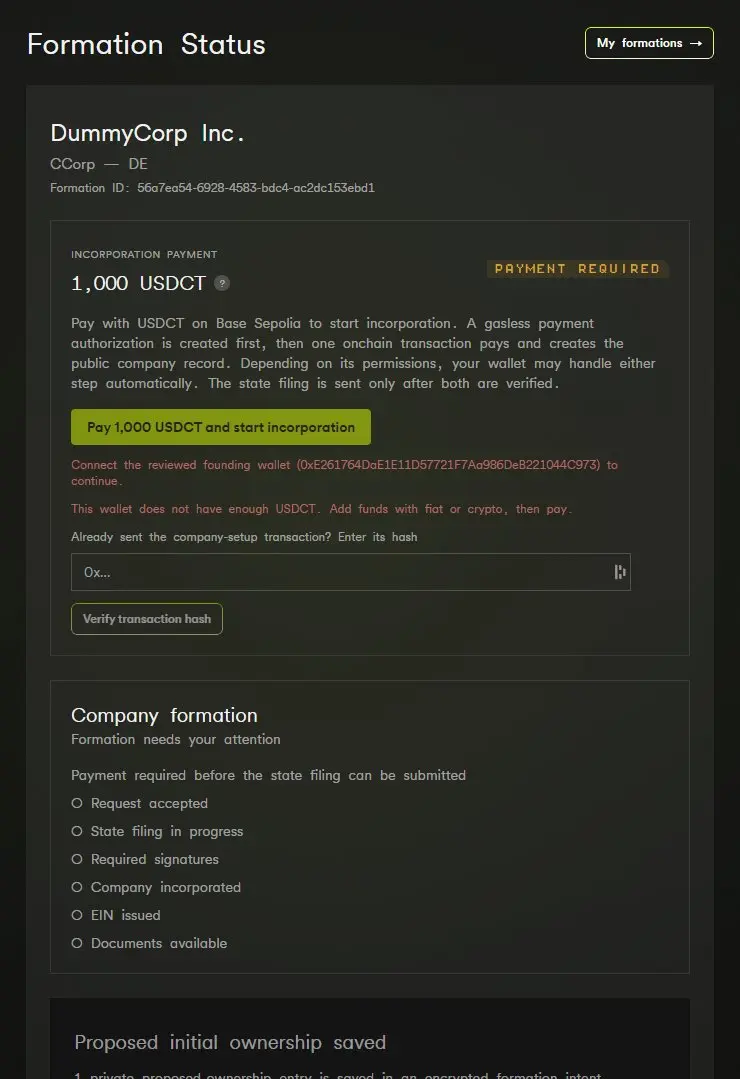
The formation status page: payment, filing progress, and required signatures in one view
When the IRS paperwork needs your signature, the SS-4 and Form 8821 show up right there under "Required signatures," and you e-sign them in the app. No DocuSign detour; we already rebuilt signing from first principles. Your executed formation documents accumulate in a private legal documents section on the same page, and anything the formation still needs from you (a pending payment, an unsigned document, an officer waiting to be seated) surfaces as a task on your company's Mission Control, so the process cannot silently stall while you are off doing founder things. Once your company exists, all of this folds into the company's permanent Incorporation Hub, where it sits alongside everything the company signs and files afterward.
The Incorporation Hub: the private state formation record and the public onchain record, together
Mission Control organizes your tasks, reminders, and recent activity
Your Cap Table is Locked & Loaded
The founder split is the first thing every startup decides and the last thing it writes down properly. The usual sequence is that four people agree on the numbers in a room, somebody types them into a spreadsheet, and eight months later a lawyer reconstructs what everyone meant during a financing.
If you filled in the proposed ownership section, MetaLeX carries those numbers forward for you. Once your payment and your public company record are both verified, the app creates the Common Stock class you asked for and stages your proposed holders as visible, non-counting draft positions in the cap table, while the state filing continues on its own track. You do not have to wait for the certificate to come back before your cap table exists.
The proposed initial ownership section: roles are suggestions, stakeholders are chosen deliberately
Formation-staged draft positions: visible, non-counting, waiting for the owner's issuance review
The word "draft" is deliberate. Issuing the stock is a separate, explicit step, taken by the owner after reviewing the terms, the consideration, and the expected federal exemption, because that step has legal consequences and should feel like it does.
The cap table's formation setup: staged proposals, explicit guardrails, and walletless-holder onboarding
Your Board Room is Open
Most formations end with a folder of PDFs and a to-do list titled "corporate housekeeping" that nobody opens until a lawyer asks for it during diligence. A MetaLeX formation ends in the boardRoom, the governance hub of your new company, already populated with the people you named:
The boardRoom: officers, directors, governance documents, and board approvals, populated from formation
- Corporate authority. The officer roster, populated from your formation. Officers you named who have not yet taken their seat appear inline as pending, one click away from it.
- Board of directors. The director-titled subset of that roster seeds the board section, so the humans your certificate of incorporation contemplates and the humans who can sign board consents are the same humans.
- Governance documents. Bylaws, charters, and other governing instruments, executed and archived in the app, findable the day diligence asks for them.
- Board approvals. Board consents your directors create, sign, and track in the app. When your board approves something, the approval is a verifiable record rather than an email thread with "LGTM" from three directors.
- Board multisig. A preview of where this goes next: board-level authority exercised through a multisig whose signers are the directors of record.
Board approvals: an externally executed consent recorded against the exact positions it authorizes
The boring-but-mandatory layer of running a corporation (officers, directors, consents, approvals) is administered in the same place the company was born; nobody has to reconstruct it later from that PDF folder. (For the deeper story of where this governance architecture comes from, see BORG OS Under the Hood.)
The Startup Superapp
Formation is the front door to where MetaLeX is headed: a startup superapp, one app in which your company is formed, governed, financed, and its ownership recorded. Because the company was set up on MetaLeX, everything a young startup does next is already wired in. Raise your first round on cyberRaise; if you are a token project, ACE aligns your tokenholders with your equity. LeXcheX verifies your investors, cyberSign executes every agreement along the way, and when you issue equity, you do it through the Tokenization Hub (which we introduced to the world as Mainframe).
Because a corporation formed through this flow gets MetaLeX-form bylaws that designate the chain as its stock ledger (for Delaware companies, under DGCL §224's express blessing of blockchain records), those records are the definitive ones rather than a copy kept alongside the real thing (the architecture behind that is the MetaLeX Securities Tokenization Protocol, for the curious). The cap table piece is included in your formation for life; the incumbent model, by contrast, is a growing annual subscription for the privilege of keeping a list of your own shareholders. No re-entering the cap table into a second system, and no reconciling the signing tool against the spreadsheet: the records that formation created are the records everything else uses.
We will concede what the incumbent formation services get right: they made incorporation cheap and fast relative to the $5,000 law firm engagement it replaced. The critique is that they stop at the filing receipt, leaving the company's entire operating life (its stock ledger, its officers, its governance documents, its agreements) to be reassembled by hand across a dozen disconnected tools. We kept the easy part and replaced everything after it.
Pricing and Availability
Formation is live now at cybercorps.metalex.tech. The price is $1,000 all inclusive, paid in USDC in the formation transaction itself, and it buys the state filing, the initial tax filings, thirty minutes with a startup lawyer, and lifetime access to the cap table features. C-Corps and LLCs, in every state: Delaware C-Corp, Wyoming LLC, Texas C-Corp, wherever your business actually lives, it is the same oneshot. Under the hood your company runs on Ethereum mainnet, Base, or Arbitrum; you do not need to care which unless you want to.
Already have a company? You do not need this flow at all. Bringing an existing entity onto MetaLeX is free, network fee only, and the rest of the superapp (the cap table, the boardRoom, the agreement tooling, the Incorporation Hub) is waiting on the other side.
The Dutch East India Company was born on paper because paper was the best database of 1602.
Yours doesn't have to be.