
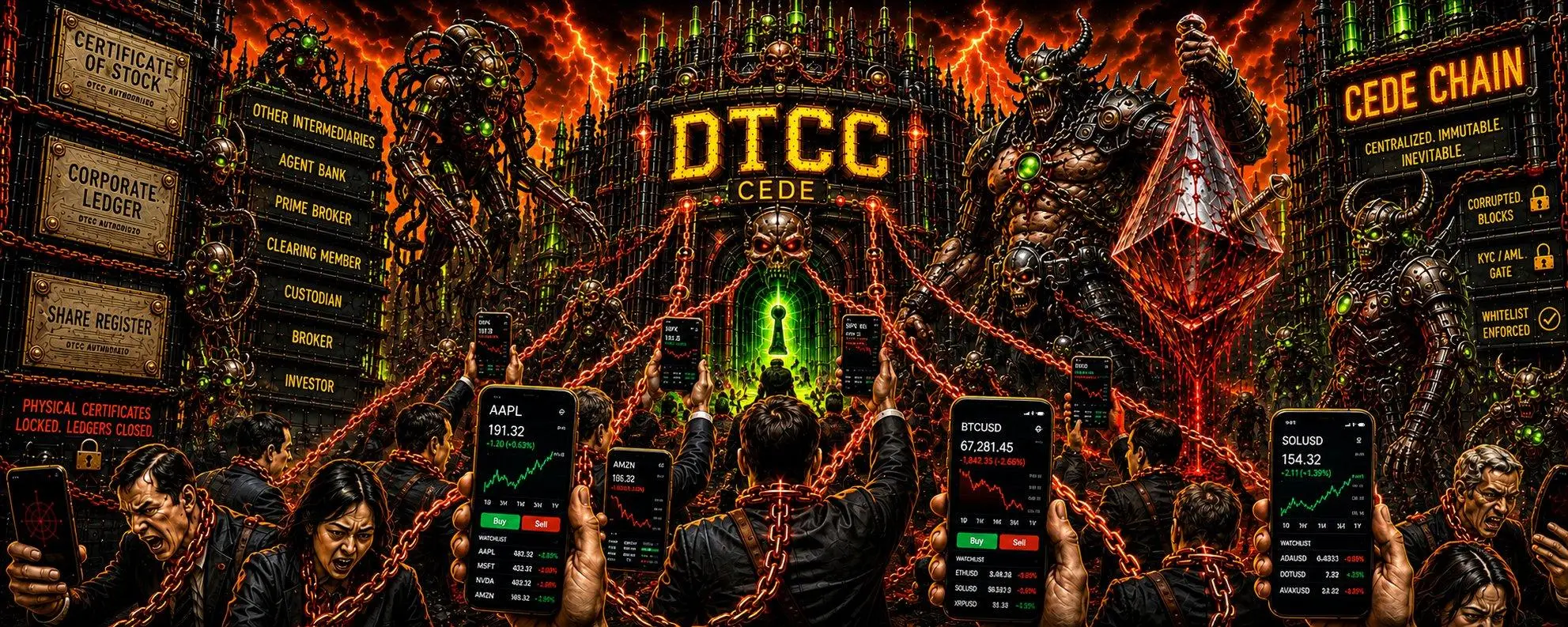
Nearly every public security in America is registered to a partnership whose name means “surrender”. Now they’re coming for crypto.
The most consequential financial institution most American investors have never thought about processed $4.7 quadrillion of securities transactions last year.
That institution is the Depository Trust & Clearing Corporation, and it sits beneath the exchanges, brokers and trading apps that investors mistake for the market itself. Its subsidiaries clear, settle, custody and service securities across essentially the entire American capital market, while its depository subsidiary, DTC, provides custody and asset servicing for roughly $114 trillion of securities from more than 150 countries and territories.
At the center of DTC's ownership architecture sits one of the great jokes in American finance: Cede & Co., DTC's nominee, in whose name deposited securities are generally registered and held in fungible bulk.
Your brokerage account may say you own 100 shares of Apple. Apple's stock ledger ordinarily does not say your name. At the top of the street name system it says "Cede."
Read as an English verb: cede.
Concede.
Surrender.
Subtlety has never been the system's strong suit.
But Cede, despite the name, is the minor character. Cede is the legal avatar through which DTCC's deeper architecture becomes visible: an institution that sits not merely between investors and assets but between the intermediaries themselves, and whose centrality is so thoroughly embedded in market structure that infrastructure is routinely mistaken for law.
Brokers, custodians and transfer agents are intermediaries. DTCC is a different kind of thing. Because the difference is architectural rather than merely one of size, it deserves its own name.
I call it the ultra-intermediary: an institution that (i) intermediates the intermediaries rather than the investing public (you cannot open an account at DTC, ordinarily have no contract with it, and have no reason even to know its name); (ii) operates the root securities account layer on which the other intermediaries' books depend; and (iii) appears, through its nominee, as record holder on issuers' own ledgers, so that its books sit at the origin of the chain that eventually produces the position displayed on your brokerage app.
Nick Szabo warned that trusted third parties are security holes. DTCC is where the trusted third parties go to settle.
In three earlier articles I prosecuted much of the security token industry for intermediary cosplay: rebuilding the old custody chain with smart contracts sprinkled over it and marketing the result as disintermediation. This article is about the institution that is cosplaying blockchain the hardest, the original final boss, and what happens now that the final boss has discovered blockchain.
My contention is that beneath DTCC's custody, clearing, netting, settlement and asset servicing machinery lies something conceptually simpler, viz. an authoritative ledger of securities positions among its participants, and that public blockchains compete for an overlapping function, since they too can serve as authoritative state machines recording who owns what.
That does not make Ethereum and DTC the same kind of system, but it does make them competitors for a function: ledger versus ledger.
For years DTCC ran blockchain experiments while keeping its traditional books authoritative. It is now going considerably further: tokenizing security entitlements, placing representations of DTC-held securities onto blockchain infrastructure, integrating with public chains, and doing all of it with explicit regulatory comfort from the SEC.
The incumbent ledger is moving onto the rival ledger, Ethereum and other decentralized blockchains. The question is whether it intends to adopt those decentralized chains as they are, or domesticate them.
How DTCC "Solved" the "Paper Crisis"
DTCC has a respectable origin story. By the late 1960s, trading volume had outrun the machinery used to settle trades: securities still moved through physical certificates and manual back office processing, certificates disappeared, unsettled transactions piled up, and brokerage operations buckled under the fails. For much of 1968 the NYSE closed on Wednesdays so member firms could catch up on paperwork, which is to say that American capitalism had reached the technological frontier at which it required Wednesdays off for filing.
The certificate was the obvious bottleneck, and there were two conceptually different ways out: dematerialization (eliminate the certificate and maintain ownership electronically on the issuer's books) and immobilization (keep the certificates, concentrate them inside a depository, register the deposited securities to a common nominee, and move beneficial interests by bookkeeping instead of moving paper). The American market chose immobilization.
The easy version of the history is wrong. Congress did not order dematerialization when it enacted §17A in 1975; §17A(e) directed the SEC to end the physical movement of securities certificates in connection with broker-dealer settlement, an instruction immobilization satisfies perfectly well. What Congress did not prescribe was Cede & Co., the Article 8 entitlement architecture, DTC's membership structure, or a permanent monopoly depository. Those came with the machine. DTC had already launched in 1973, and once certificates were immobilized at the depository, transactions among participants could be reflected electronically rather than through armies of clerks hauling engraved paper around lower Manhattan. It worked: central immobilization, book-entry settlement and netting were spectacular improvements over sacks of certificates, and DTC deserves real credit for solving an actual problem well. Then the workaround became the architecture.
The 1994 revision of UCC Article 8 supplied the commercial law machinery required to describe the indirect holding system honestly, because pretending every brokerage customer owned some identifiable certificate sitting inside DTC's vault no longer described reality. Article 8 created the "security entitlement," which brings us to an irresistible slogan: you don't own your stocks. The slogan is also legally sloppy, so let me kill it before a securities lawyer does. If you hold stock through an ordinary brokerage account, you generally are not its registered owner; you hold a security entitlement against your securities intermediary. However, that entitlement is no naked unsecured IOU: Article 8 gives entitlement holders serious property rights, including a pro rata property interest in the financial assets the intermediary maintains for its entitlement holders and protection against the intermediary's general creditors.
Thus the system did not abolish property; it re-architected property around intermediaries. Whereas the old relationship ran:
issuer → registered stockholder,
the street name default runs:
issuer → Cede/DTC → DTC participant → (perhaps another intermediary) → broker → investor.
Nor were the drafters of revised Article 8 villains secretly confiscating everyone's stocks: they were cartographers, mapping a market structure that already existed and building a thoughtful property regime around it. A good map can still tell you where the property went. The paper crisis ended; the workaround got tenure.
Anatomy of an Ultra-Intermediary
Return to the 100 Apple shares on your screen. At the issuer level, securities deposited into DTC are generally registered to Cede; DTC maintains positions for its participants; and beneath that layer, clearing firms, custodians and brokers maintain their own positions and customer accounts. There is no Apple Share No. 872,144,019 sitting in a database with your name beside it. What you have is an entitlement against a fungible pool: real property, but not registered ownership of an identified share on Apple's ledger.
That structure instantiates each element of the ultra-intermediary definition. DTCC's counterparties are themselves intermediaries; its depository subsidiary operates the root securities account layer for those intermediaries; its nominee appears as record holder for an enormous amount of American corporate equity; and ordinary participation in the public securities markets has become so thoroughly organized around its infrastructure that participation looks less like a consumer choice than an environmental condition. You choose your broker; at the bottom of the funnel sits DTCC.
The distinction becomes clearest under what I have called the "walkaway test": if the intermediaries disappear, what remains? Suppose your broker fails. The legal system has answers, and they are not primitive answers held together with staples: Article 8, customer segregation rules, reconciliation requirements, SIPA, SIPC and specialized insolvency machinery all exist for exactly this kind of case. But Apple's stock ledger cannot simply be queried for your name, because your name was never there. That is the difference between protecting ownership through an intermediary system and making the owner directly legible to the constitutive ledger. Usually the difference is invisible, because DTCC's machinery works; architecture becomes visible when it bleeds. So: receipts. Dell, Procter & Gamble, Dole, GameStop and one flooded basement, none of which needs to be alleged on information and belief, because all of it is filed, certified, reported or litigated.
How DTCC Strips Your Stock of All Actual Rights
A share is more than price exposure: it carries voting rights, inspection rights, appraisal rights in applicable transactions, litigation rights and a legally significant relationship with the corporation. Street name ownership does not erase those rights; it routes them. Modern corporate law has spent decades building bridges across that routing, and Delaware now expressly accommodates beneficial owners in important contexts: qualifying beneficial owners can exercise §220 inspection rights subject to proof requirements, and current §262 permits qualifying beneficial owners to make appraisal demands in their own names. The interesting question is why the bridges were needed. Voting shows the architecture most cleanly: because Cede is the registered owner for securities deposited at DTC, DTC distributes voting authority outward from that registered position, while beneficial owner instructions travel back through participants, custodians, brokers and proxy processors before becoming votes attributable to the record position. Most elections resolve without drama; close elections are where the machine takes its shirt off.
Dell
T. Rowe Price thought Michael Dell's 2013 buyout of Dell Inc. was too cheap, and funds and clients holding roughly 31 million shares intended to seek appraisal. T. Rowe then made an extraordinary mistake: its own automated proxy voting system generated instructions voting those shares for the merger. The mistake was T. Rowe's, but the machinery performed it flawlessly: the erroneous instruction travelled through the proxy infrastructure and became the legally relevant vote associated with the shares, and the Court of Chancery held that the affected shares had lost appraisal eligibility. A few weeks later, the same court valued Dell at $17.62 per share against the $13.75 merger consideration, and T. Rowe eventually announced that it would pay affected clients approximately $194 million. DTCC did not make T. Rowe press the wrong button; the intermediary architecture made the wrong button dispositive. Delaware later amended §262 to permit qualifying beneficial owners to demand appraisal directly, i.e., a $194 million software patch, written into the corporate code.
Procter & Gamble
The 2017 proxy contest between Procter & Gamble and Nelson Peltz is cleaner still, because no button was mispressed and the numbers refused to hold still. P&G initially announced that Peltz had lost; the independent inspector's preliminary tabulation then put Peltz ahead by 42,780 shares, approximately 0.0016% of shares outstanding; and after challenge and reconciliation, the final certified count put incumbent director Ernesto Zedillo ahead by 498,312 votes, whereupon P&G appointed Peltz to the board anyway. Between preliminary tabulation and final certification, the relative result moved by 541,092 votes in a contest whose apparent margin had been 42,780. No crypto founder invented that number for a pitch deck. Nor is any of this news to the regulator: the SEC devoted a 2010 concept release to precisely this machinery, including overvoting, undervoting, securities lending, position reconciliation and the problem of confirming whether beneficial owner instructions actually made it into the final vote. The system knows where its bodies are buried; it has concept releases for them.
A History of Real & Impactful System Failures
Every infrastructure system makes mistakes; the useful failures are the ones that reveal what the system is actually representing. Dole is almost indecently good evidence.
Dole
In 2017, Vice Chancellor Laster had to distribute settlement consideration to a class containing 36,793,758 Dole Food shares, and claimants submitted facially valid claims for 49,164,415. Not 49 million shares outstanding, and not counterfeit certificates: facially valid claims for roughly 12.4 million more shares than belonged in the class. The discrepancy largely arose from two features of the market structure, viz. the then-applicable T+3 settlement cycle (during which more than 32 million shares traded immediately before closing) and short selling and stock lending activity that further complicated any reconstruction of beneficial ownership. The issuer's stock ledger could not answer the question because the economic owners were downstream of Cede and DTC, and there was no single canonical beneficial owner ledger the court could query and go home. So the court sent the money through DTC for participants to allocate downstream: the machinery whose distributed records made ownership expensive to reconstruct was also the only machinery available to reconstruct it. Laster pointed toward distributed ledger technology as a possible route to a cleaner ownership record. That was 2017. We have since spent nine years tokenizing the receipts.
GameStop
GameStop exposed a different part of the stack. Before the market opened on January 28, 2021, Robinhood Securities faced an NSCC clearing fund requirement vastly larger than expected and responded by restricting purchases of GameStop and several other volatile stocks while scrambling for capital and relief. NSCC is part of DTCC: different subsidiary, same stack. The congressional investigation later found that NSCC had assessed roughly $9.7 billion of Excess Capital Premium charges across six member firms that morning and then waived that component across the board. Discard, therefore, the cartoon in which NSCC explicitly trades a waiver for Robinhood shutting off the buy button; the record does not establish it, and the established version is damning enough. Millions of people thought they were interacting with a stock market through a brokerage app, and the constraint that suddenly determined whether they could press BUY arose from a collateral calculation at a DTCC clearing corporation several institutional layers away. For a few hours the UI peeled off, and retail saw the machine.
Some GameStop holders then drew the obvious architectural conclusion and moved shares through the Direct Registration System into their own names at Computershare. By March 20, 2024, GameStop reported approximately 75.3 million shares registered with its transfer agent in names other than Cede, against approximately 230.6 million held by Cede on behalf of DTC participants. Subsequent issuances and changes in registered holdings reduced the directly registered percentage, but the historical fact remains extraordinary: a mass retail movement learned the difference between the DTCC/Cede architecture and appearing directly on the issuer's register, and then changed categories. Direct registration had spent decades as a dusty side door; GameStop holders found the handle.
The Atlantic Ocean Performs an Audit
Then there is the vault. DTC's foundational choice was immobilization, not necessarily destruction of the underlying paper: certificates could remain legally or operationally relevant so long as they stayed put while ownership interests moved electronically. In October 2012, Superstorm Sandy sent millions of gallons of contaminated water into the basement and sub-basements of 55 Water Street, and more than 1.7 million certificates were waterlogged. To DTCC's credit, its business continuity systems worked: core clearing and settlement continued without interruption, and recovery teams later descended five flights into the vault to retrieve and restore the damaged certificates. Nevertheless, thirty-seven years after Congress ordered an end to the physical movement of certificates in broker-dealer settlement, 1.7 million pieces of paper still mattered enough to recover from a flooded basement beneath lower Manhattan. DTCC did not kill the certificate; it taught the certificate to stay home. Then the Atlantic Ocean performed the audit.
DTCC's Entrenched Monopoly Grows Stronger and Stronger
At this point defenders of the architecture usually reach for necessity: surely some statute requires DTCC. It does not. Section 17A created and regulates the national clearance and settlement system, but Congress did not decree DTC the eternal depository of the American capital markets or require Cede to appear as registered owner for most deposited public equity. The lock-in lives lower in the stack, which is where modern monopolies prefer to live: SRO rules require use of depository facilities for book-entry settlement of depository eligible securities; listing rules generally require depository eligibility where available; brokerage practice defaults to street name; transfer agents interface with DTC; custody agreements, margin systems and securities lending programs assume the Article 8 environment; clearing economics punish fragmentation; and network effects do the rest. In 2003 the SEC even approved a DTC rule clarifying that issuers themselves could not simply order deposited securities withdrawn from DTC, because withdrawal instructions had to come through DTC participants. There is no statute saying THOU SHALT CEDE; there does not need to be, because every locally sensible rule points toward the same pipe.
Nor is any conspiracy required. Brokers want cheap settlement, exchanges want certainty, DTC participants want netting, regulators want stability, issuers want liquidity, investors want to trade with one click, and commercial lawyers want coherent rules for the system actually in front of them. Everyone has an excellent reason, which is how path dependence wins: each decision is defensible alone, and together they produce a market in which replacing DTCC sounds insane because almost every surrounding institution has been built on the premise that DTCC will not be replaced. No one designing a securities ownership system from a blank page would say: "Hmmm, you know what I think we should do? Register nearly every public equity to a single nominee partnership, let economic ownership live in a web of contractual entitlements several intermediaries deep, and then spend fifty years building statutory bridges so the actual owners can occasionally exercise the rights of owners." While market structure often evolves in that messy fashion and ends up in a workable place despite the mess, no one would proceed down such a torturously convoluted path on purpose.
DTCC is also legally recognized as too important to fail chaotically: DTC, NSCC and FICC are designated systemically important financial market utilities under Title VIII of Dodd-Frank, and regulators quite reasonably supervise them as infrastructure whose disorderly failure could threaten financial stability. However, there is an obvious political economy to becoming indispensable. Once an institution becomes infrastructure whose disappearance is unthinkable, preserving the institution becomes a regulatory objective, and the emergency workaround acquires a federal halo. DTCC describes itself, accurately, as industry owned and governed, and a cooperative of toll collectors has excellent incentives to keep the toll booth cheap, solvent and immaculately maintained; it has fewer natural incentives to pave a road around itself. Thus the paperwork crisis produced centralized depository settlement, later crises strengthened centralized clearing and risk management, and GameStop accelerated T+1, which is the same architecture moving faster. The system metabolizes criticism. Blockchain poses a different problem, because a common authoritative ledger can make several intermediaries' separate authoritative books unnecessary: a threat to the job description rather than a feature request. DTCC's response has been very smart.
DTCC's Blockchain Efforts: Cooption and Reterritorialization, not Adoption
Project Ion is the clean early exhibit. By 2022, DTCC said Ion was processing more than 100,000 bilateral equity transactions per day in a parallel production environment, with one small detail: DTC's classic settlement system remained the authoritative record. Ion could improve the machinery; it could not become the truth. That is DTCC's blockchain strategy in miniature: the chain may compute, but the database decides.
DTCC then acquired Securrency, built DTCC Digital Assets, launched Digital Launchpad and developed additional distributed ledger infrastructure, and in December 2025 the strategy matured into regulatory text, when SEC staff issued DTC a no-action letter covering a preliminary tokenization program. Commissioner Hester Peirce's description does most of the prosecution's work unaided: the program tokenizes security entitlements held by DTC participants, and DTC's software tracks transfers for DTC's official books and records. I could rest here. These are not shares escaping DTCC; they are tokenized entitlements inside DTCC.
On July 15, 2026, DTCC announced that DTC-held securities had been converted into tokens and used in production transactions spanning equity and Treasury DVP, securities lending, collateral and margin workflows, with more than thirty firms participating and the broader Tokenization Service scheduled to launch commercially in October. DTCC describes the blockchain objects as tokenized representations, or "digital twins," of DTC-held securities and says they preserve the same investor protections, entitlements and ownership rights as the conventional assets. The same entitlements: there is the confession, filed as a feature. The security remains inside the DTCC/DTC legal and custody architecture, the token represents the entitlement, and DTC's books remain operative, so the blockchain changes the rails without changing who owns the station. Earlier security token startups built a token and pointed it at somebody else's custody database; DTCC can point the token at itself, which is much cleaner. And DTCC is taking the model onto public blockchain infrastructure, including a planned Stellar connection.
In the taxonomy I have used throughout this series, this is pointer tokenization executed at institutional scale: the chain is a notification and mobility layer over an external authoritative registry, here DTC's official books and records. The naming matters because a token existing on a public blockchain does not make that blockchain the authoritative ownership ledger. One question separates the models: if blockchain state and DTCC state disagree, which one has legal effect? If the answer is DTC's official books, the public chain has not replaced the incumbent ledger; it is carrying messages for it. Carrying messages is honorable work, and real-time collateral mobility, programmability, interoperability, better securities lending workflows and improved DVP are all useful, for intermediaries. What the program is not is disintermediation. It is an upgraded ultra-intermediary: a company town with a block explorer.
And this is where cooption becomes reterritorialization. Why fight the rival technology when you can define its successful form as a feature of your own product? DTCC is positioned to make the commercially important meaning of "blockchain securities" something very specific: DTCC securities with blockchain accessories. Project Ion supplied the template (blockchain as parallel book, DTC as authoritative source); the 2025 no-action program moved further (tokenized security entitlements, DTC official books and records); the July 2026 transactions put the model into production; October is the commercial launch; and public chain integrations follow. Nobody is hiding the architecture. The question is whether crypto can distinguish DTCC adopting blockchain from blockchain replacing DTCC, which are opposite outcomes wearing the same press release.
Scaling the Legacy System is a Red Herring
DTCC executives have also made the scale argument: public blockchains cannot simply absorb the volume DTCC handles. Grant the premise arguendo; it answers the wrong question. DTCC's subsidiaries processed $4.7 quadrillion of securities transactions in 2025, an astonishing number generated inside an intermediated architecture: clearinghouses exist because huge quantities of gross obligations arise among participants and can then be netted before final settlement, and NSCC nets away the overwhelming majority of the gross obligations presented to it. Why would a replacement architecture reproduce every internal event generated by the incumbent one? Judging a constitutive ledger by whether it can reproduce every gross claim, allocation, reconciliation event and message inside DTCC is like asking whether email can carry enough envelopes to replace the Postal Service. The envelopes were the problem.
Of course, netting is capital efficient, atomic settlement can increase liquidity demands, and securities financing, cash settlement, compliance, privacy, error correction and corporate actions do not disappear because the ledger moved. Fine. However, the serious blockchain thesis was never database fast, blockchain faster; it is that a common authoritative state machine can eliminate categories of reconciliation among institutions that currently maintain separate books, and a replacement architecture is measured partly by the work it no longer needs to perform. Bragging about the quadrillion without decomposing it is bragging about the overhead.
The Kingmaker Problem: the Subtle but Massive Risks of Bringing Ultra-Intermediaries onto Decentralized Autonomous Blockchains
DTCC's tokenization program creates a subtler problem than custody, and potentially a more important one. In 2019, Haseeb Qureshi and Leland Lee published "Ethereum is now unforkable, thanks to DeFi," built on a simple thought experiment: Ethereum splits into two contentious chains, and while ETH can exist on both, USDC cannot, because a dollar claim against a real issuer cannot remain meaningfully redeemable on two contradictory ledgers unless the issuer recognizes both. Circle therefore has to choose a canonical branch, and on the other branch the copied USDC remains technically present while its institutional referent does not. Once enough DeFi depends on externally anchored assets, that recognition decision propagates through the system. Qureshi and Lee called such assets "unforkable components."
By the same token, the analysis runs, mutatis mutandis, with DTC-tokenized securities in place of USDC. Note what I am not arguing: DTCC is not putting $114 trillion onto Ethereum tomorrow, and it does not need to. The variable that matters is how much economically important DTCC-recognized property becomes embedded in a host chain's financial system. Every DTC-tokenized entitlement has an institutional referent outside the chain by design, so although token balances can copy to both branches of a fork, the entitlement cannot: DTC has to recognize some canonical state for its official books, the branch DTCC recognizes carries the institutional claim, and the other branch has a souvenir.
That gives the ultra-intermediary a new species of power, which I will call recognition power: the ability to determine which branch of a blockchain's history carries institutional meaning. Circle stumbled into a version of it as stablecoins colonized DeFi; DTCC arrives with it built into the instrument. Consider the token holder's bargain: the holder receives smart contract risk, network risk, fork risk, reorg risk and interoperability risk, but if DTC's books remain authoritative, the holder does not receive symmetrical blockchain authority against DTCC. When the chain and DTCC disagree, somebody wins, and the architecture has already told you who. Heads I (DTCC) win, Tails you (not DTCC) lose.
None of this requires DTCC to maliciously capture anything; institutional power is rarely that theatrical. Imagine a future contentious protocol upgrade involving transaction ordering, privacy, compliance architecture or some other feature important to regulated institutions. The chain splits, and DTCC announces which branch its tokenized securities will recognize. Every institution holding those assets has an enormous reason to prefer that branch, every lending market accepting them inherits the preference, and every application dependent on those markets inherits it again. DTCC needs no protocol governance seat; the legal referent votes for it. That is the Qureshi-Lee kingmaker problem at institutional scale, and it also reframes the competition among blockchain foundations to attract tokenized "real world assets": the foundations think they are selling blockspace, but they may also be selling pieces of their fork sovereignty.
The Alternative: Putting Entities Onchain is Cypherpunk
There is another model, and Delaware made it legally possible years ago. DGCL §224 permits a corporation's stock ledger to be maintained using electronic networks or databases, expressly including distributed electronic networks or databases, so long as the statutory requirements are satisfied. That does not mean token + Ethereum = stock; the architecture has to be legally constituted. The corporation's governing arrangements and stock ledger mechanics must make the distributed record part of its authoritative books and records; transfer restrictions still matter; Article 8 still matters where applicable; transfer agent regulation may matter; and identity and compliance remain stubbornly alive. But the design space exists, and I call it constitutive tokenization. In a constitutive model, the blockchain-based system is the stock ledger: its state transition changes registered ownership because the corporation has organized its books so that the transition is legally operative. The token does not point to the share; the registered state is the share ownership record. No Cede layer is inherently required, no security entitlement is needed merely because the security trades, and the holder can appear as registered owner. That is real ledger competition: pointer versus constitutive.
The commercial law establishment has now put the constitutive architecture on paper too. In April 2026 the Permanent Editorial Board for the UCC published a draft report for public comment concerning tokenized securities transfers. Much of it considers conservative implementations (tokens functioning as transfer instructions, control mechanisms and other ways to automate conventional securities relationships), but then it stops being conservative: the draft identifies the possibility that the platform itself can constitute the issuer's books and records, with token transfer concurrently producing a change in registered ownership, and points expressly toward statutes such as DGCL §224. The report carefully avoids crypto metaphysics about whether "the security itself" somehow lives inside the blockchain, and rightly so (who cares?), because commercial law has recognized the architecture that matters: the platform can be the register.
Once the platform is the register, several of the pathologies catalogued above change character. A constitutive stock ledger cannot itself report 49 million registered shares belonging to a 36.8 million-share Dole settlement class; external economic claims can proliferate without becoming the canonical registered ownership state. Registered holders can vote positions derived directly from the authoritative ledger rather than routing instructions through layers of beneficial ownership. And if the securities leg and an acceptable cash leg settle atomically, a trade need not create the same interval of unsettled counterparty exposure that a central counterparty collateralizes in the conventional architecture. Blockchains do not abolish the capital markets' problems, but they can abolish some of their bookkeeping problems, and that is enough. The distinction reduces to the question the marketing is engineered to blur: which ledger is law? In pointer tokenization, DTCC-style, blockchain state represents a legal position whose authoritative institutional machinery remains elsewhere; in constitutive tokenization, blockchain state can itself be the issuer's authoritative ownership record. One model improves the ultra-intermediary; the other competes with it.
Putting entities onchain is cypherpunk.
DTCC Should not Decide Forks
Constitutive tokenization does not eliminate RWA issuer choice regarding forks; it decentralizes it and makes sure that since there are many many issuers (every individual issuer) vs. one (DTCC representing all issuers), no one has kingmaking power.
Where an asset is anchored to an external legal referent, recognition power cannot be abolished, only allocated: a dollar liability, a custodied Treasury and a Delaware corporation each ultimately correspond to legal facts outside the blockchain, and two contradictory branches cannot indefinitely be the authoritative representation of one set of those facts. A constitutive security is no exception. If the authoritative stock ledger lives on Ethereum and Ethereum splits, the issuer must determine which branch remains its stock ledger, just as Circle must determine which branch carries recognized USDC. So the real design questions are: (1) who holds the recognition power; (2) over how much; (3) answerable to whom; and (4) pursuant to rules written when. Measured against those variables, I humbly submit that DTCC is close to the worst available allocator.
Who? A single institution, capable of making one recognition decision across tokenized interests in securities of thousands of unrelated issuers and, through composability, the protocols entangled with them.
Over how much? Potentially an asset base large enough that recognition ceases to be an input into a fork dispute and becomes the outcome. Trillions and trillions of dollars of bluechip assets, far outweighing any fears of undue stablecoin issuer influence (billions of dollars at current levels).
Answerable to whom? Primarily to the regulated institutional structure surrounding DTCC and its participant owners, not to the public chain community whose history its designation may effectively select, and not directly to every ultimate token holder whose economic position depends on the choice.
There is also an incentive problem: the protocol upgrades most likely to produce meaningful conflict with the incumbent financial system may be precisely the ones that alter privacy, settlement, market structure or institutional control, and the entity whose business model depends on intermediation is a strange constitutional guardian for a chain trying to decide how much intermediation it wants.
Now invert the allocation. Under a constitutive model, recognition power is disaggregated to each issuer severally: thousands of separate corporate decisions rather than one marketwide designation, each concerning that issuer's own security, each made under that issuer's governing documents and applicable fiduciary framework, and each capable of being specified before the fork.
As an example of constitutive tokenization, @MetaLeX_Labs' cyberCORPs protocol treats chain divergence as a defined Material Adverse Exception Event, so the governing documents can specify ex ante how a fork or divergence gets resolved, with exercises of the relevant authority recorded onchain and bounded by the documents themselves. Fork policy becomes a published term of the security: holders can read it, markets can price it, and courts can review exercises of corporate power against it. The fork answer becomes law before it becomes news. Because corporate securities cannot float free of the entities that issue them, some designation power necessarily remains, and the question is where to put it: one centralized recognition decision for the market, made by the ultra-intermediary whose participants are the incumbent intermediaries, or many issuer-level decisions, each constrained by the legal architecture of the security whose fork is being resolved? I'll take the second failure mode.
The SEC Is Holding Both Doors Open
The regulatory picture is more interesting than the usual SEC versus crypto nursery story. In December 2025, SEC staff gave DTC its no-action position for tokenized security entitlements. Four months later, the Division of Trading and Markets issued a staff statement addressing certain software interfaces used to prepare transactions in crypto asset securities from self-custodial wallets: subject to the statement's conditions, staff said it would not object to Covered User Interface Providers operating without broker-dealer registration merely because they perform the specified interface functions (the position is temporary and expires after five years absent intervening Commission action). Put the two developments side by side. Down one path, DTCC tokenizes Article 8 entitlements inside the depository; down the other, users transact from self-custodial wallets through software that, within the staff's conditions, need not itself become a broker-dealer intermediary. The SEC has not selected one architecture. Good; it should not. Let them compete, but make them compete under honest names, because a DTC security entitlement represented on a blockchain is not the same architecture as a security whose registered ownership is constituted by blockchain state. A better depository is not no depository, and "tokenized security" should not become a category mushy enough to conceal the only question worth asking: which ledger is law?
Time to Take Back Control
None of this means Apple can click a button tomorrow and escape DTCC; that would be crypto fan fiction. The incumbent architecture carries fifty years of accumulated dependencies (SRO rules, exchange practices, participant agreements, transfer agent integrations, custody systems, securities lending markets, margin systems, Article 8 documentation and millions of investors already holding through intermediary accounts), and migrating an existing public float is principally a coordination problem rather than a smart contract problem. So attack the architecture where incumbency is weak: new issuers; private markets; companies whose securities have never entered DTC; and eventually public companies designed from formation around a constitutive stock ledger rather than trying to claw registered ownership back after their float has disappeared into street name. Incumbency is strongest where the old system already exists and weakest at genesis, which is why DTCC's tokenization campaign matters now: left uncontested, "blockchain securities" will come to mean DTCC securities with blockchain accessories before constitutive alternatives reach scale.
Accordingly, some assignments. Founders should ask whether their cap tables need to enter the DTCC/Cede entitlement chain at all. Investors should apply the walkaway test to everything marketed as a tokenized security (if the broker, custodian, depository or proprietary database disappears, what remains?), or better yet ask the sharper question: if blockchain state and institutional state disagree, which record has legal effect? Public chain ecosystems should ask what recognition power accompanies assets whose legal meaning depends on DTCC accepting the chain's history. Regulators should permit genuine competition between direct and indirect holding systems rather than letting depository eligibility calcify into a synonym for investor protection. And the security token industry needs to decide what business it is actually in: better custody is useful, modern settlement is useful, and DTC positions on Stellar may be useful, but there is still something ridiculous about delivering all three and calling the result disintermediation. If DTCC's proprietary books remain authoritative and the blockchain records a claim against that architecture, you have not replaced the ledger; you have given DTCC a blockchain interface. The moat now has excellent APIs.
For more than fifty years the American securities market has quietly converged on an architecture dominated by an institution almost nobody outside finance understands. DTCC clears the trades, settles the trades and maintains the depository; its nominee sits on the issuer's register; and that nominee carries an accidentally perfect name:
Cede. Concede. Surrender.
The technology now exists to make the investor legible to the issuer's ledger again:
Strive. Thrive. Tokenize.
It's time to use blockchain's true disruptive, disintermediating potential, rather than spending another fifty years pouring concrete into DTCC's moat and calling it a TradFi/Defi bridge.